The Golden Hour: Why the 45 Minutes Before Sunset Define Your Entire Wedding Gallery
Every experienced wedding photographer guards the golden hour fiercely. This fleeting window — when the sun hangs low and the world turns amber — produces images that no artificial light can ever replicate.
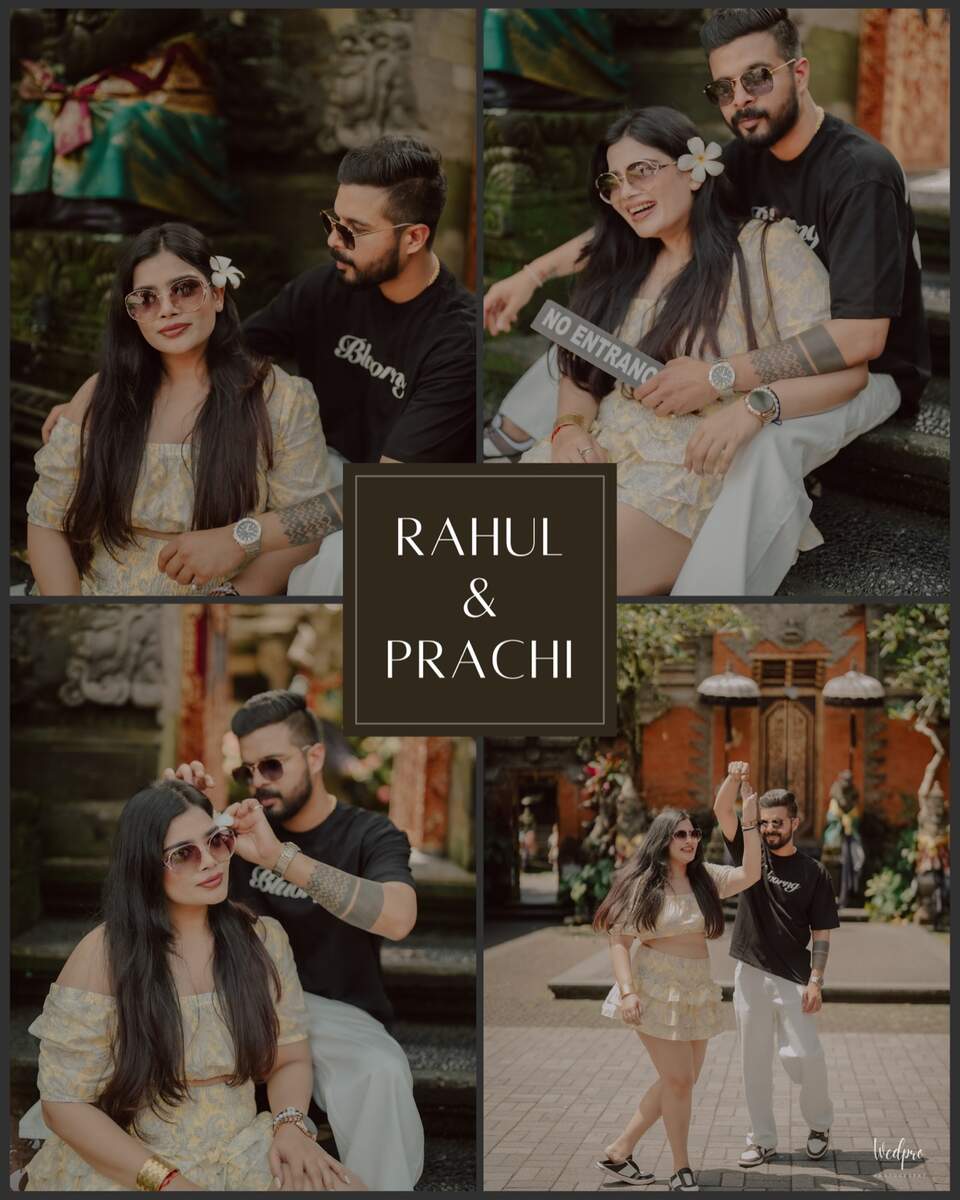
There is a moment in every wedding day that experienced photographers wait for with something close to reverence. It arrives approximately forty-five minutes before the sun touches the horizon, and it lasts no more than sixty minutes before fading into the blue of dusk. Photographers call it the golden hour. Wedding photographers call it the difference between beautiful photographs and extraordinary ones.
In all of our years photographing weddings across Delhi, Rajasthan, and internationally, no artificial lighting setup — however expensive or carefully conceived — has ever produced the quality of light that the sun provides in that final hour before it sets. Understanding this, planning for it, and protecting it within your wedding timeline is one of the most important things you can do to ensure exceptional photography.
What Exactly Is Golden Hour Light?
Golden hour is the period immediately after sunrise and immediately before sunset when the sun is close to the horizon. At this angle, sunlight travels through a significantly greater depth of atmosphere than it does at midday. The atmosphere scatters shorter wavelengths (blue and violet) and allows the longer wavelengths (red, orange, and yellow) to pass through predominantly. The result is a warm, amber-golden light that is softer, more directional, and infinitely more flattering than any other natural light available during the day.
For photography — and for wedding photography specifically — this light has several specific qualities that make it exceptional. It is warm, which means it flatters all skin tones and adds richness to bridal outfits. It is directional but soft, which means it creates gentle shadows that add dimension without being harsh. And it often produces a luminosity — a kind of inner glow — in photographs that is almost impossible to create artificially.
Why Wedding Timelines Often Destroy the Golden Hour
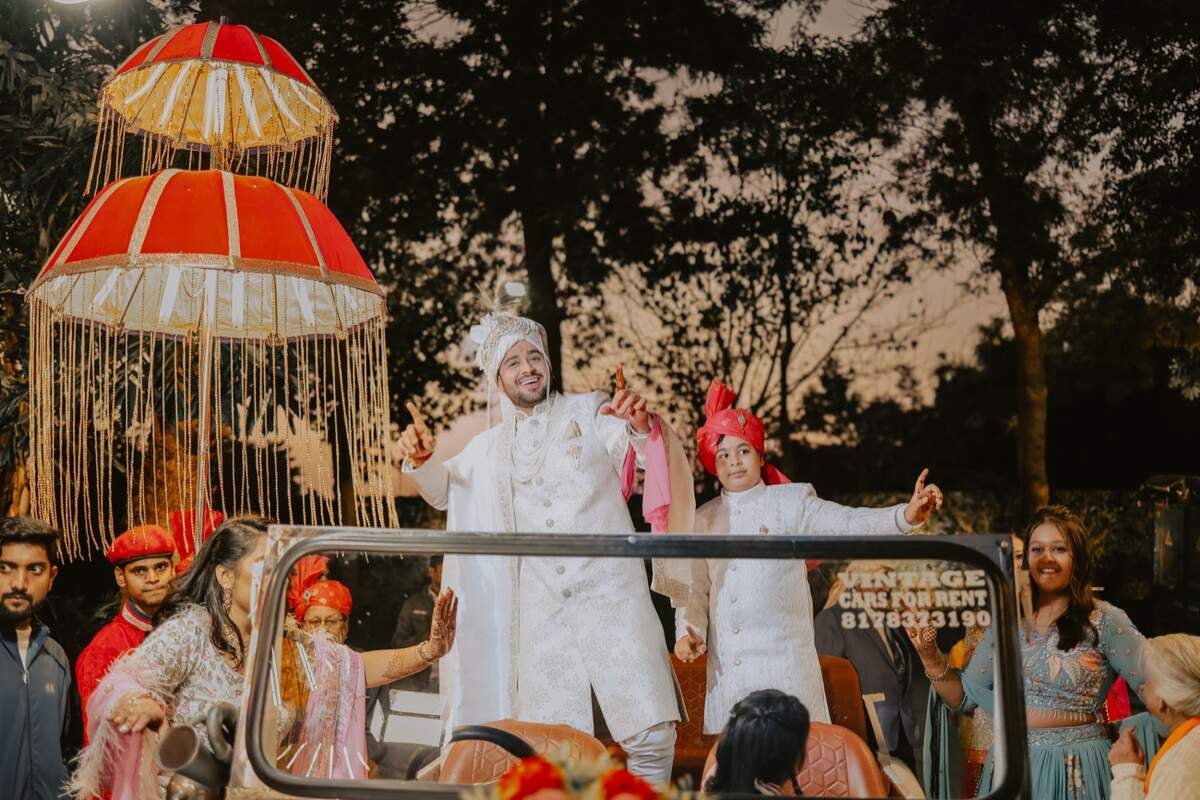
Here is a truth that most couples discover too late: in the standard Indian wedding timeline, the golden hour almost always coincides with the cocktail reception or the beginning of the wedding ceremony. Guests are being greeted, the couple is doing rounds, or the pheras are about to begin. The result is that this irreplaceable light window passes with the couple either trapped in social obligations or already photographed in the harsh artificial light of the mandap.
This is one of the most common causes of wedding photography disappointment — not the photographer's skill, but the timeline. When couples review their galleries and wonder why the outdoor couple portraits don't have that quality they admired in their photographer's portfolio, the answer is almost always light. The portfolio images were made at golden hour. The wedding portraits were made at 3pm or under venue lighting.
How to Protect Golden Hour Within Your Wedding Timeline
The solution is planning, and it requires some negotiation with your wedding planner and family. Here is how we approach this with our couples:
First, we identify the exact sunset time for your wedding date and location using astronomical data. In Delhi, this ranges from approximately 5:15pm in December to 7:15pm in June. Golden hour begins roughly 45–60 minutes before sunset. So for a December wedding, we're looking at a window from 4:15–5:15pm.
Second, we block this window in the day's timeline. This typically means scheduling the cocktail reception to begin at golden hour, so that while guests are networking and drinking, the couple can slip away for thirty to forty-five minutes for outdoor couple portraits. This is the approach used at virtually every internationally published wedding in India. The couple is not missed, the timeline is not disrupted, and the resulting images are incomparably better.
Third, we identify the specific outdoor locations at the venue that will receive the best golden hour light. This requires either a pre-wedding visit to the venue or knowledge of its orientation from previous shoots there. At WedPro, we have shot at most of Delhi and NCR's major wedding venues multiple times and know exactly where the light falls at every hour.
The Best Venues in Delhi and NCR for Golden Hour Photography
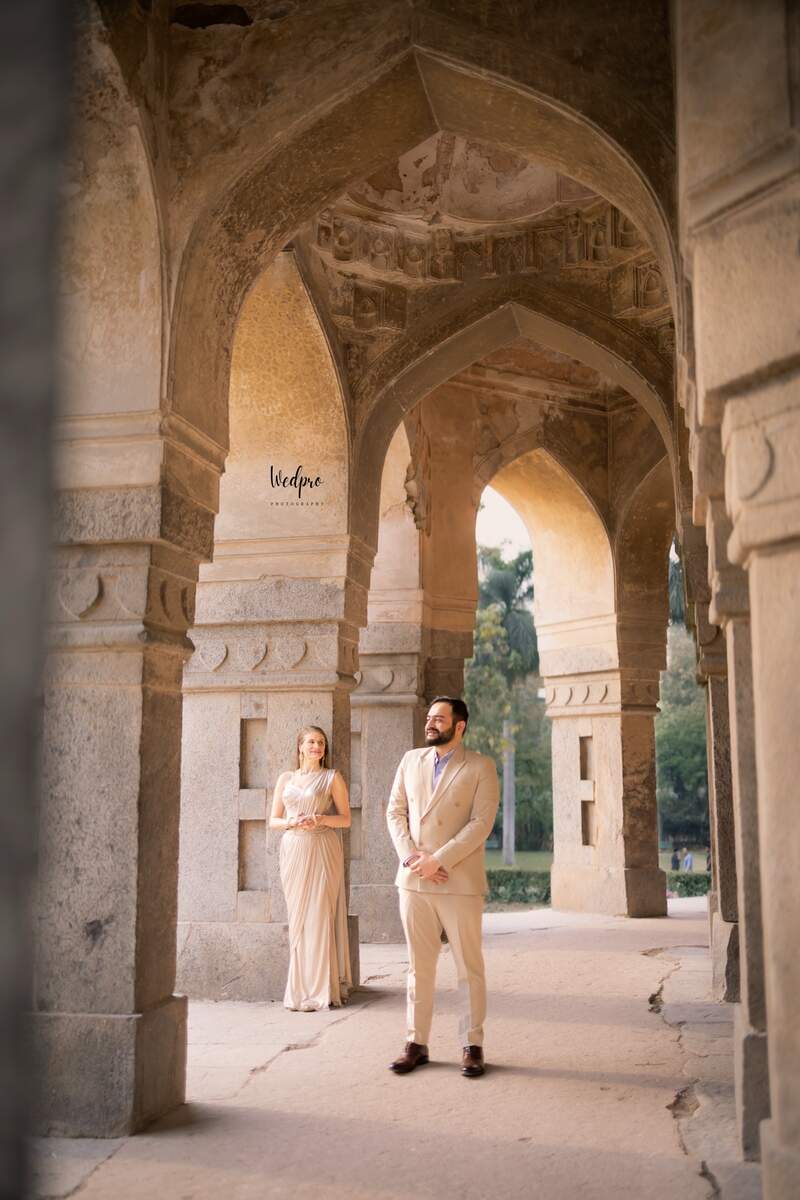
Not all wedding venues are created equal for golden hour. Venues with open western-facing lawns or terraces are ideal — the setting sun illuminates the couple from the front during the early golden hour and from behind (creating rim lighting and silhouettes) as it drops lower. Venues with water features — lakes, pools, fountains — gain an additional dimension as the golden light reflects off the water surface.
- DLF Golf & Country Club, Gurugram — west-facing fairways with extraordinary sky views
- ITC Grand Bharat, Manesar — palace grounds with open lawns and ambient garden lighting
- The Roseate, Aerocity — gardens with mature trees that create beautiful filtered golden light
- Rajokri Farms and the broader Chattarpur belt — open fields that catch the full western light
- Umaid Bhawan Palace, Jodhpur — where the desert amplifies golden hour into something transcendent
When Golden Hour Is Cloudy: The Silver Lining
Overcast golden hour is not the photographer's enemy — it is often a gift. When clouds diffuse the setting sun, the entire sky becomes a soft box. The light is less dramatic and less directional, but it is extraordinarily even and flattering. Skin tones are rendered beautifully, there are no harsh shadows, and the soft gradients of a cloudy sunset sky make extraordinary backgrounds for couple portraiture. Some of our most beautiful images have been made under overcast skies at sunset.
Delhi Winter Light: The Best Season for Wedding Photography
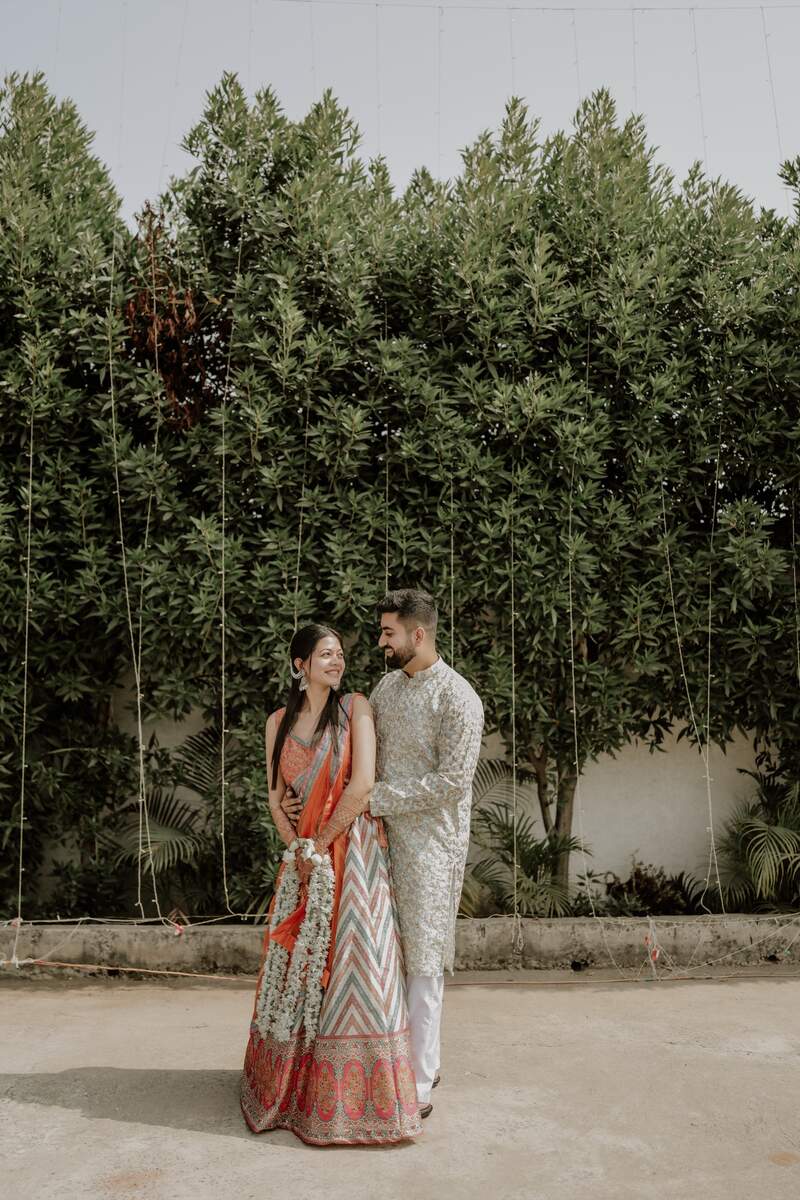
Delhi's winter months — October through February — offer the finest wedding photography conditions in India. The light quality in Delhi during winter is exceptional: low angle, warm without being harsh, with the atmospheric clarity that comes from low humidity and the absence of summer haze. The golden hour in a December Delhi wedding lasts longer and burns warmer than the golden hour at any other time of year. The deep red and gold of winter bridal lehengas catches this light with a warmth that summer light, however beautiful, cannot replicate.
In practical terms, a Delhi winter golden hour session is typically scheduled for 4:15 to 5:15pm from October to December, and for 5:45 to 6:45pm in February and March. We flag the exact golden hour window for your specific wedding date during our initial consultation and build the day's timeline around protecting that window. Couples who understand the photography value of winter light and plan accordingly consistently produce better outdoor portraits than those who schedule without this awareness.
Blue Hour: The Second Magic Window
Beyond the golden hour, there is a second magic window that most photographers and most couples overlook: the blue hour. This is the twenty to thirty minutes after the sun sets when the sky transitions from the warm afterglow of sunset to the deep, saturated blue of approaching night. During this window, the sky provides a beautiful graduated backdrop, artificial lights at the venue begin to glow in a way that feels warm and inviting rather than garish, and the quality of light on faces is extraordinarily flattering.
Blue hour images have a specific quality that is distinct from both golden hour and night photography — there is still detail in the sky, the ambient light is still soft and wrap-around, and the entire scene has a romance and mystery that golden hour images do not always carry. For couples who have a venue with attractive exterior lighting, a garden with warm-lit pathways, or a rooftop with a city view, the blue hour session can produce some of the most distinctive and memorable images of the entire wedding day. We typically propose an extended portrait session that begins in the final golden hour and continues through the blue hour when the timeline allows.
A Note to Our Couples
When we say we need thirty minutes with you during golden hour, we are not being greedy with your time. We are asking for the single most valuable thirty minutes of the entire wedding day from a photography standpoint. The images we make in those thirty minutes will, in all likelihood, be the ones you return to most often for the rest of your lives. We promise to make every minute count. Read our complete wedding photography guide for more on how we plan the day to maximise the available light, and visit our portfolio to see the specific quality that golden hour produces. To discuss your specific wedding date and the golden hour window it will offer, reach out to us directly.

WedPro Photography
Delhi's leading wedding photographers — crafting visual legacies since 2012.