Photographing Multi-Day Indian Weddings — A Behind-the-Scenes Story
Three days. Five ceremonies. Four hundred guests. Two photographers. Zero sleep. This is what it really takes to photograph a full Indian wedding — and why we wouldn't trade it for anything.
People ask us sometimes what it is like to photograph a multi-day Indian wedding. The honest answer is that it is one of the most demanding, physically exhausting, creatively exhilarating experiences that professional photography offers. It is also, consistently, the work we are most proud of.
This is a behind-the-scenes account of a typical three-day wedding in Delhi — what we actually do, how we prepare, and what goes into producing a gallery that will endure for generations. It is not a sales pitch. It is simply an honest description of the craft.
Day Zero: The Preparation
The day before a multi-day wedding begins, we complete our preparation. This means a final gear check — every camera, every lens, every battery, every memory card tested and confirmed. For a three-day wedding with two photographers, we carry eight camera bodies, twelve lenses, four flash systems, three tripods, portable LED lighting panels, and enough storage for approximately 40,000 images. Everything has a backup. In twelve years of wedding photography, we have never missed a shot due to equipment failure because we have never allowed equipment failure to be possible.
Preparation also means reviewing our shot list notes from the couple, confirming the day's timeline with the wedding planner, and identifying the specific moments and groupings that are most important to this particular family. Every wedding is different. A family where the grandparents are elderly and may need to be photographed early in the day requires a different approach to a family where the eldest generation is vigorous and will be dancing until midnight. We plan for the specific family we are photographing, not a generic Indian wedding family.
Day One: Mehendi and Sangeet — The Warm-Up
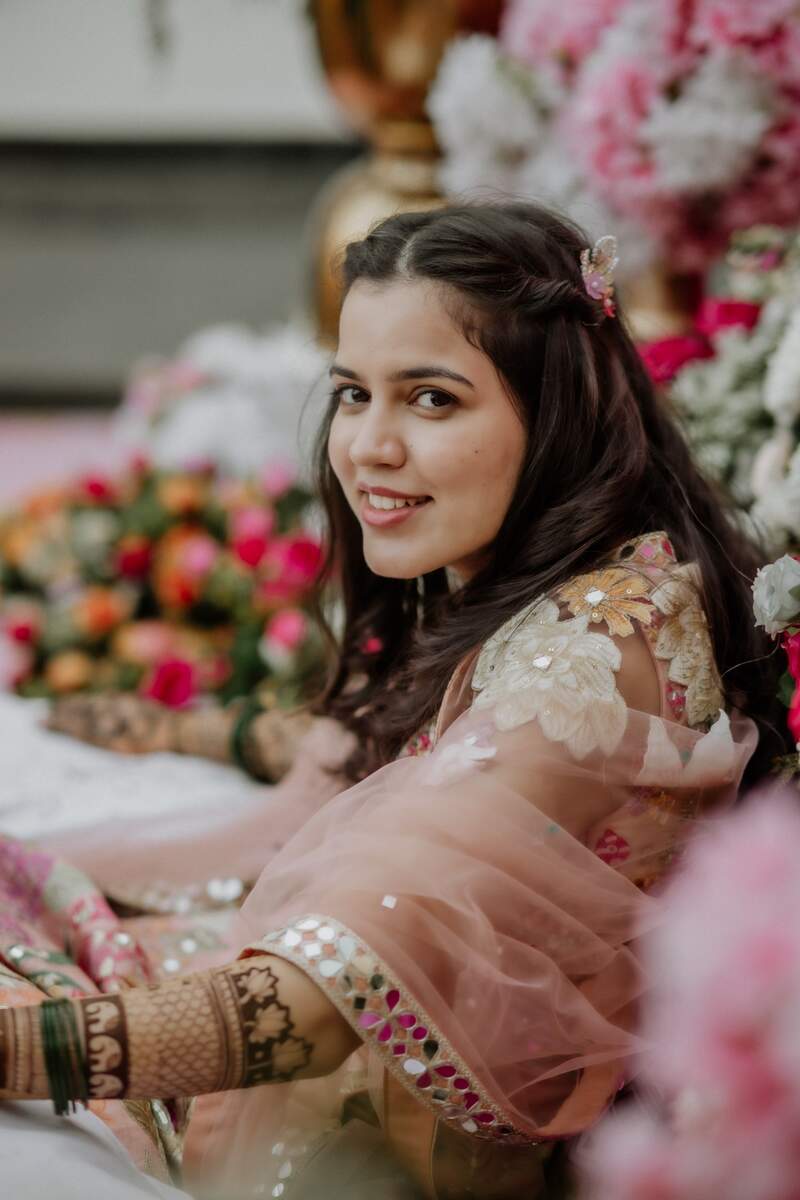
Day one typically begins with the Mehendi ceremony in the afternoon — usually at the bride's home or a rented space. We arrive forty-five minutes before the ceremony begins to assess the light, position ourselves, and ensure our equipment is appropriately calibrated for the environment. The Mehendi is where the couple and their families begin to truly see us — how we work, how unobtrusive we are, how we handle ourselves in a family space.
The transition to Sangeet typically happens in the same evening. The light changes, the energy changes, the music begins. For photographers, the Sangeet represents a particular challenge: it is a low-light, high-energy performance environment where the key subjects are moving constantly and the background is often chaotic with guests, décor, and varying light sources. This is where the quality of a photographer's low-light technique is most clearly revealed.
By the time the Sangeet ends, we have typically been on our feet for ten to twelve hours. Memory cards are backed up twice before sleeping. Tomorrow is a bigger day.
Day Two: Haldi — The Most Honest Ceremony
The Haldi ceremony is our favourite to photograph. There is something about turmeric paste being applied by loving hands — the yellow against the bride's skin, the laughter when it gets in her hair, the genuine tenderness of parents and siblings performing this ancient ritual — that produces photographs of extraordinary human warmth. Nobody is dressed elaborately for Haldi. Nobody is performing for guests. The masks that come with formal occasions are temporarily absent, and what remains is pure family love.
Photographically, Haldi is a close-quarters, intimate event. We work with wide-angle lenses that allow us to be close to the action without the intrusion of telephoto compression. The colour palette — turmeric yellow, white kurtas and sarees, green mango leaves — is one of the most photogenic in the entire Indian wedding calendar. And the emotional range within a single hour — from raucous laughter to quiet tears — gives a photographer everything they could ask for.
Day Two Evening: Baraat and the Wedding Ceremony
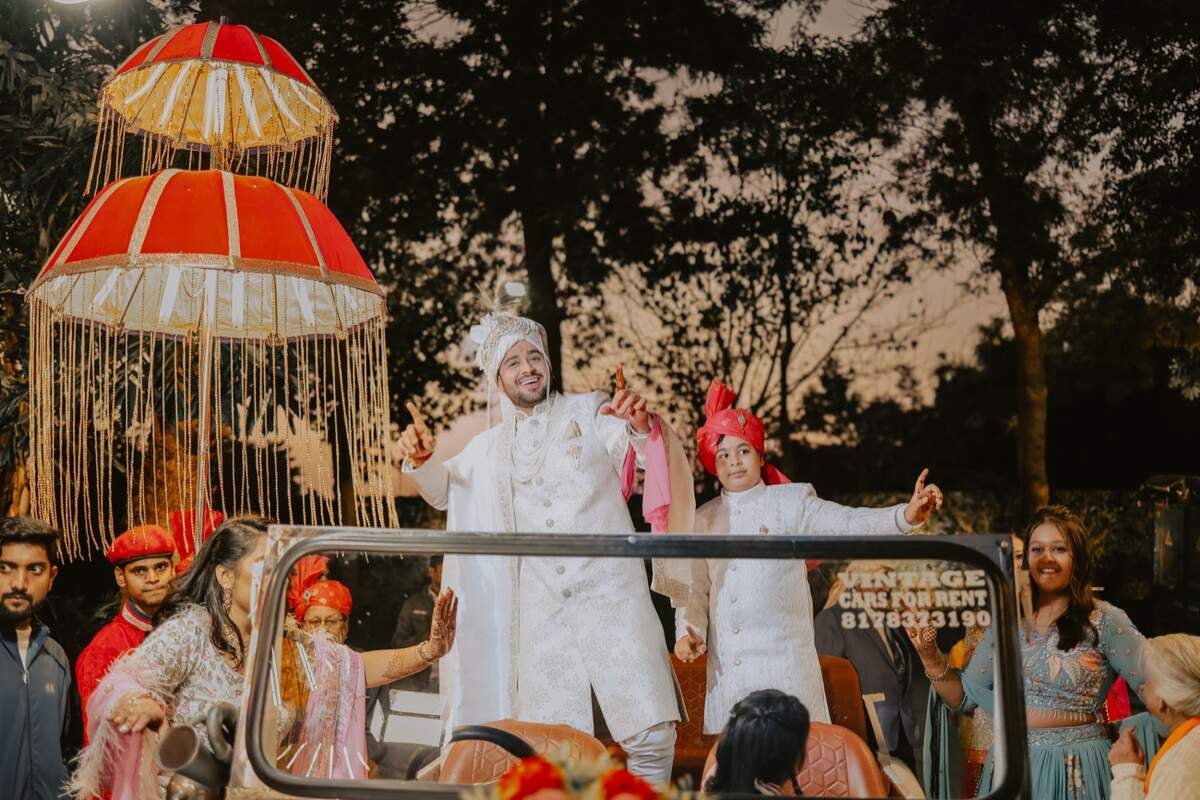
The Baraat is noise, movement, and joy in its most concentrated form. The groom on a white mare, the dhol players driving the crowd, the families dancing in the street — this is the kind of spectacle that requires both photographers working simultaneously. One stays close to the groom for intimate expressions and family moments; the other works wide for the scale and energy of the procession.
The wedding ceremony itself — the pheras, the saptapadi, the mangalsutra and sindoor — requires a different approach entirely. We slow down. We become quieter. The ceremony is sacred and we treat it as such. One photographer positions for the ceremony's key ritual moments; the other moves constantly through the guests, capturing the reactions that are often more emotionally powerful than the ceremony itself.
This is the part of the day where twelve years of experience becomes visible. Knowing which ritual comes next, knowing which angle will give the cleanest composition at the mandap, knowing when to be forward and when to recede — these are intuitions built through hundreds of weddings, not something that can be learned from a tutorial.
The Vidaai — The Hardest Shot in Wedding Photography
The Vidaai is, without question, the most emotionally intense moment of an Indian wedding. The daughter is leaving her family home, possibly for the last time as a permanent resident. There is a specific quality of grief in a Vidaai that exists nowhere else — it is grief mixed with pride, loss mixed with joy, the bittersweet weight of a life's chapter ending and another beginning simultaneously.
Photographing the Vidaai requires a very particular emotional steadiness. We have photographed hundreds of these moments and we are still moved by them. The challenge is to hold that emotion and channel it into the photography — to find the specific expression on the father's face, the specific way the bride's hands hold her mother's for the last time before the car door closes — without becoming so overwhelmed by the moment that the photography suffers. This balance is something we take seriously.
After the Wedding: The Edit
The wedding ends but our work does not. The editing process for a three-day wedding involves reviewing approximately 25,000–35,000 images, selecting the 1,200–1,800 that will comprise the final gallery, and editing each one individually. Colour grading, exposure correction, skin retouching where needed, black-and-white conversions for selected images — this process takes four to six weeks and is as important to the final quality of the photographs as anything that happened during the three days of shooting.
When the gallery arrives in our couple's inbox, it contains the distilled essence of three extraordinary days — not every moment, but every important moment, every beautiful moment, every moment that will still matter in forty years. That is what we make. That is what we love to make. That is why, despite the exhaustion and the physical demand, we would not trade this work for anything.
How We Stay Sharp Across Three Days
The physical and mental demand of a multi-day Indian wedding is something that most clients never see, and most photographers who have not done it extensively significantly underestimate. Three days of twelve to sixteen hour shooting days, combined with the mental load of continuously tracking faces, relationships, rituals, and lighting conditions, places demands on human concentration that require genuine management. At WedPro, our approach to multi-day weddings includes crew rotation — different photographers covering different events to ensure that no single team member is carrying the full weight of all three days. The lead photographer maintains creative continuity and relationship management throughout; associate photographers rotate coverage responsibilities so that every event has a fully energised team.
Sleep, nutrition, and hydration are operational priorities, not afterthoughts. We have shot enough multi-day weddings to know that a team running on poor sleep and deferred meals makes technical errors, misses moments, and produces editing work that reflects their depleted state. We build adequate rest windows into our multi-day wedding schedule and we communicate transparently with our clients when we need to structure the team's schedule to ensure peak performance throughout. This is not a luxury — it is what professional service to a three-day wedding actually requires.
What Couples Ask Us Most Often About Multi-Day Coverage
The most common question we receive about multi-day wedding photography is about the album. How do you fit three days of coverage into a single album? The honest answer is that you do not — not without editorial choices. A three-day wedding album requires a curatorial approach that a single-day album does not. The album design process for a multi-day wedding is about identifying the narrative thread across all three days and presenting it as a coherent story rather than a comprehensive archive. The full documentary archive lives in the digital gallery; the album is the edited, curated version of that archive that can be held and shared.
Our wedding photography service includes full multi-day coverage planning as a standard part of the pre-wedding consultation. Our luxury album service includes specific design options for multi-day celebrations. Visit our portfolio to see multi-day wedding galleries, and contact us to discuss how we would approach your specific multi-day celebration. Our pricing page shows how multi-day coverage is structured and quoted.

WedPro Photography
Delhi's leading wedding photographers — crafting visual legacies since 2012.
Related Services